The adapa Group Way: Preparing Cosmetics and Home Care Packaging for PPWR Without Compromising Performance
The European Packaging and Packaging Waste Regulation (PPWR) is fundamentally changing packaging requirements across Europe. The regulation sets significantly higher standards for the recyclability of packaging and aims to accelerate the transition towards a functioning circular economy. The adapa Group supports cosmetics and home care manufacturers throughout this transformation with packaging solutions that combine sustainability with industrial performance.
For many manufacturers, the key challenge is to meet the new regulatory requirements without compromising the efficiency of existing production processes. On high-speed production lines in particular, limited sealing windows, reduced machine speeds or increased waste rates can quickly offset the benefits of new packaging concepts.
The adapa Group therefore views the transition to Design for Recycling (D4R) not merely as a material change, but as an industrial transformation. Material properties, processability and compatibility with existing production equipment are critical to successful implementation. Development projects are closely aligned with customers’ production processes and validated under realistic industrial conditions from the earliest development stages. “PPWR turns recyclability from a general commitment into a concrete, verifiable requirement,” says Michelle Marrone, Head of Sustainability at adapa Group. “For cosmetics and home care manufacturers, that means packaging solutions must prove themselves on the production line and afterwards within European recycling centers, so not just on paper.”
Wet Wipes: Process Reliability Under Demanding Conditions
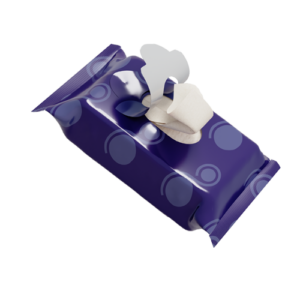
Packaging for wet wipes are among the most demanding applications in flexible packaging. Packaging structures must process reliably even at high machine speeds, provide sufficient stiffness for stable machinability and ensure permanently tight seals that protect the product against moisture loss throughout its entire shelf life. Formulations containing alcohol or other aggressive ingredients further increase the demands placed on packaging materials.
Mono-material structures based on PP or PE offer a clear route towards improved recyclability. Depending on the application, recycled content can also be incorporated. The solutions developed by the adapa Group can contain up to 30% chemically recycled post-consumer recycled (PCR) content in PP structures and up to 50% mechanically recycled PCR in PE structures, provided the product is not in direct contact with the packaging film.
Because mechanically recycled PCR exhibits greater variations in melt flow rate and mechanical strength than virgin polymers or chemically recycled materials, the adapa Group tests new film structures directly on customers’ production lines. Parameters such as seal integrity, web handling and achievable machine speeds are evaluated under realistic production conditions. The results provide manufacturers with greater planning reliability and reduce implementation risks when introducing new packaging solutions.
Drawstring Bags: High PCR Content for High-Volume Production
Drawstring bags for home care applications are manufactured in very high volumes and therefore offer considerable potential for increasing recycled content. The adapa Group has developed mono-PE systems containing approximately 80% mechanically recycled post-consumer recycled (PCR) material. At the same time, conventional viscose drawstrings are replaced with fully recyclable PE alternatives, ensuring compatibility of the entire packaging solution with existing recycling streams.
For converters and brand owners, however, high recycled content alone is not sufficient. Closing performance, processability and production efficiency must be maintained despite the increased PCR content. By developing materials that are compatible with established converting parameters, the adapa Group enables customers to significantly increase recycled content without compromising process stability. Several manufacturers have already successfully integrated these packaging solutions into serial production.
Refill Pouches: Driving Resource Efficiency Through Reuse and Recyclable Packaging
Refill solutions are becoming increasingly important as brands seek to improve resource efficiency by enabling the reuse of existing rigid primary packaging through flexible refill formats, while reducing material consumption and offering more sustainable packaging concepts.
However, many refill pouches currently on the market still consist of non-recyclable multi-material laminates. Transitioning to mono-material solutions therefore requires a careful balance between recyclability, product protection and process reliability.
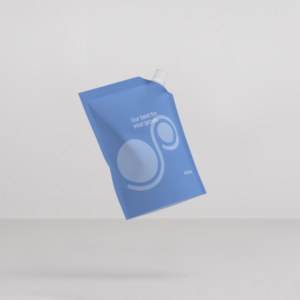
Refill pouches for liquid and semi-liquid products must meet demanding technical requirements. They must withstand drop tests, provide reliable seals even when the sealing area is contaminated by product residues and integrate into existing filling lines with minimal modification. To meet these requirements, the adapa Group develops recyclable mono-material solutions capable of replacing conventional laminates with little or no process adjustment. Extensive industrial trials evaluate drop resistance, seal reliability and filling-line performance before new structures are approved for industrial implementation.
PPWR: Combining Recyclability with Industrial Performance
The PPWR defines the regulatory framework for recyclable packaging advancing a circular economy in Europe, thanks to recyclable packaging, recycled content, and reusable solutions. Its success will ultimately depend on whether these solutions can be implemented on an industrial scale without compromising process stability or production efficiency.
The adapa Group develops PPWR-compliant packaging solutions in close cooperation with partners across the entire value chain and validates them at an early stage on industrial production equipment. The result is packaging with high process reliability and dependable performance on high-speed production lines – a key prerequisite for successfully advancing the circular economy.
About adapa Group
adapa Group is the European partner of choice for flexible packaging solutions. Adapting to the evolving needs of customers in food, tobacco, home- & personal care and healthcare industries, adapa offers efficient solutions that are crafted to perform and designed to be circular. adapa’s expertise spans over decades, evolving from a group of family-owned businesses to a leading European supplier of flexible packaging. From extrusion to printing and converting, adapa’s knowledge runs deep. With highly experienced centres of excellence across Europe, adapa speaks their customers language – be it Dutch or cheese.